A broom finish is the practical default: simple, grippy, easy to clean and easy to patch. A stamped or patterned finish costs more and buys appearance, usually with sealing every few years. HomeGuide puts stamped concrete at $8–$19 per square foot installed nationally. Every project is quoted on site.
What is a broom finish, and why is it the standard?
A broom finish is exactly what it sounds like. After the slab is poured, leveled and floated smooth, the finisher drags a stiff broom across the surface while the concrete is still soft. That leaves fine parallel grooves you can feel with your hand. It is the most common exterior finish in North Texas for a reason: it is quick, it is consistent, and it gives the surface texture without adding anything to the concrete.
Those grooves are the whole point. A smooth, trowel-finished slab looks good indoors but turns slick outdoors when it rains or when someone steps out of a pool. The broom texture gives shoes and bare feet something to hold on to. That is why you see it on nearly every driveway, sidewalk and patio approach around town.
Maintenance is simple. Rinse it, sweep it, and use a hose or a pressure washer when it gets dirty. You can seal a broom-finished slab if you want, and sealing helps with stains, but the surface does not depend on a sealer to look right.
What does a stamped or patterned finish actually change?
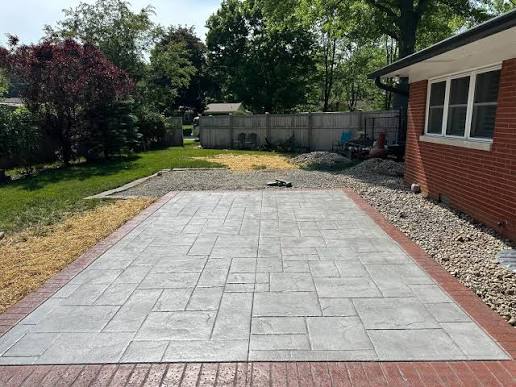
A stamped finish is still the same concrete. The difference is in the finishing stage. Instead of brooming, the crew presses patterned mats into the surface while the concrete is plastic, usually working with color and a release agent so the pattern reads clearly. The result is a slab that can imitate stone, brick or tile shapes while remaining one continuous pour.
That extra work is where the cost difference comes from. More labor on the day of the pour, more material, and a tighter window to get it right before the concrete sets. HomeGuide lists stamped concrete nationally at $8 to $19 per square foot installed, compared with lower figures for a plain finish. Those are national averages, not Fort Worth prices, and every project is quoted on site after we see access, size and site prep.
Patterned surfaces are also sealed as part of the finish and generally need resealing periodically to keep color and sheen. Plan on that as part of owning the patio, not as an optional extra. You can read more about what drives the overall number in our guide to concrete patio cost in Fort Worth.
Side by side: how the two finishes compare
Appearance. A broom finish is plain and uniform. A patterned finish adds shape and color and reads as a designed surface from across the yard. If the patio is the view from your kitchen window, that matters more than it does on a side walkway.
Traction. Broom texture is grippy by design. A patterned surface has texture too, but it comes from the stamp profile, and a sealer can make it slicker when wet. If you expect wet feet, say so before the pour so the finish and sealer are chosen with that in mind.
Cleaning and upkeep. Broom grooves hold a little dirt but rinse out easily. Patterned surfaces have deeper joint lines that collect leaves and grit, and the sealer needs renewing on a cycle. Neither is difficult, but the patterned slab is the one that asks for attention.
Repairs. This is the practical dividing line. A patch in a broom finish can be re-broomed to blend in. A patch in a patterned, colored surface rarely disappears, because matching an aged color and a stamped texture on a small area is close to impossible. If a tree root or a future addition is likely to disturb part of the slab, that is worth weighing.
Cost direction. Broom is the lower-cost choice in every case, because it is the base finish. Pattern, color and borders all add labor on pour day.
What matters specifically in North Texas
Heat is the first thing to think about. A patio in full afternoon sun gets hot underfoot in a Texas summer regardless of finish, and darker colors absorb more. If the patio is uncovered and the kids will be barefoot on it, lean toward lighter color and plan for shade. Under a covered porch or a pergola, color is a free choice.
Pour timing matters more with patterned work. Concrete sets faster in heat and wind, and stamping has to happen inside that window. On hot days that means starting early and staffing the pour properly. We cover the weather side in more detail in our post on how North Texas weather affects curing.
Vehicle loads change the conversation. Anything cars drive on should be specified for that load with the right thickness and reinforcement, and the finish choice comes second. A broom finish is the normal answer on a driveway for traction and for ease of future repair.
The middle option: a plain field with a decorative border
You do not have to pick one or the other across the whole slab. A common and sensible approach is a broom-finished field with a decorative border, a banded edge, or a shaped layout that follows the house. You get most of the visual effect at the edges, where the eye lands, and keep the simple, grippy, easy-to-patch surface where people actually walk and set furniture.
Layout does a lot of work here too. A curved edge, a circular feature, or a patio shaped to match the back of the house reads as custom even with a plain finish. That is the kind of thing we work out on paper before we form anything, and you can see examples of finished surfaces in our project gallery.
How we work through the finish decision
Junior Concrete has been doing concrete work for 15 years, and finish is one of the things we talk through before anything is formed. We walk the site, look at sun exposure, how you plan to use the space, what the house and existing surfaces look like, and what the slab has to carry. Then we put the scope and the finish in a written estimate so there are no surprises on pour day.
If you want the full range of layouts and finished outdoor surfaces, start with our decorative concrete page. If you are still working out size and placement, concrete patios covers site preparation, forming, pouring and finishing.
Estimates are free. Call (817) 210-5188 or send a message through the contact page, and we will come look at the space. We work by appointment Monday through Saturday across the Fort Worth and Dallas area.
Frequently asked questions
- Can a pattern be added to concrete that is already poured?
- Not in the same way. Stamping happens while the concrete is still soft, so it cannot be done to a cured slab. Overlay products exist, but they sit on top of the existing surface and depend on that slab being sound. If you want a patterned look on an existing patio, we will look at the condition of the slab first and tell you honestly whether it is worth doing or whether replacement makes more sense.
- Does the finish change how strong the slab is?
- No. Strength comes from the mix, the thickness, the reinforcement and the base underneath — not from what the surface looks like. A stamped patio and a broom-finished patio built to the same spec will carry the same load. Finish is an appearance and surface-texture decision made on top of a slab that should already be built correctly.
- Which finish is easier to keep clean?
- Broom. Its grooves are shallow and rinse out with a hose. Patterned surfaces have deeper joint lines that trap leaves and grit, and the sealer on them needs renewing on a cycle to keep looking right. Neither takes much work, but broom is the lower-effort surface year to year.
- Is a broom finish slippery when wet?
- That is the problem it is designed to solve. The broom grooves give traction that a smooth troweled surface does not have, which is why it is standard on exterior walks and driveways. If a surface will be wet often, mention it during the estimate so the texture and any sealer are chosen with that in mind.
- How do I decide if I am still torn?
- Think about use before looks. If the surface takes vehicles, is likely to be cut into later, or sits in full sun where bare feet will be on it, broom is usually the right call. If it is a visible, shaded, purely social space, a pattern or a decorative border is money that shows. We will give you our read on it when we walk the site.