
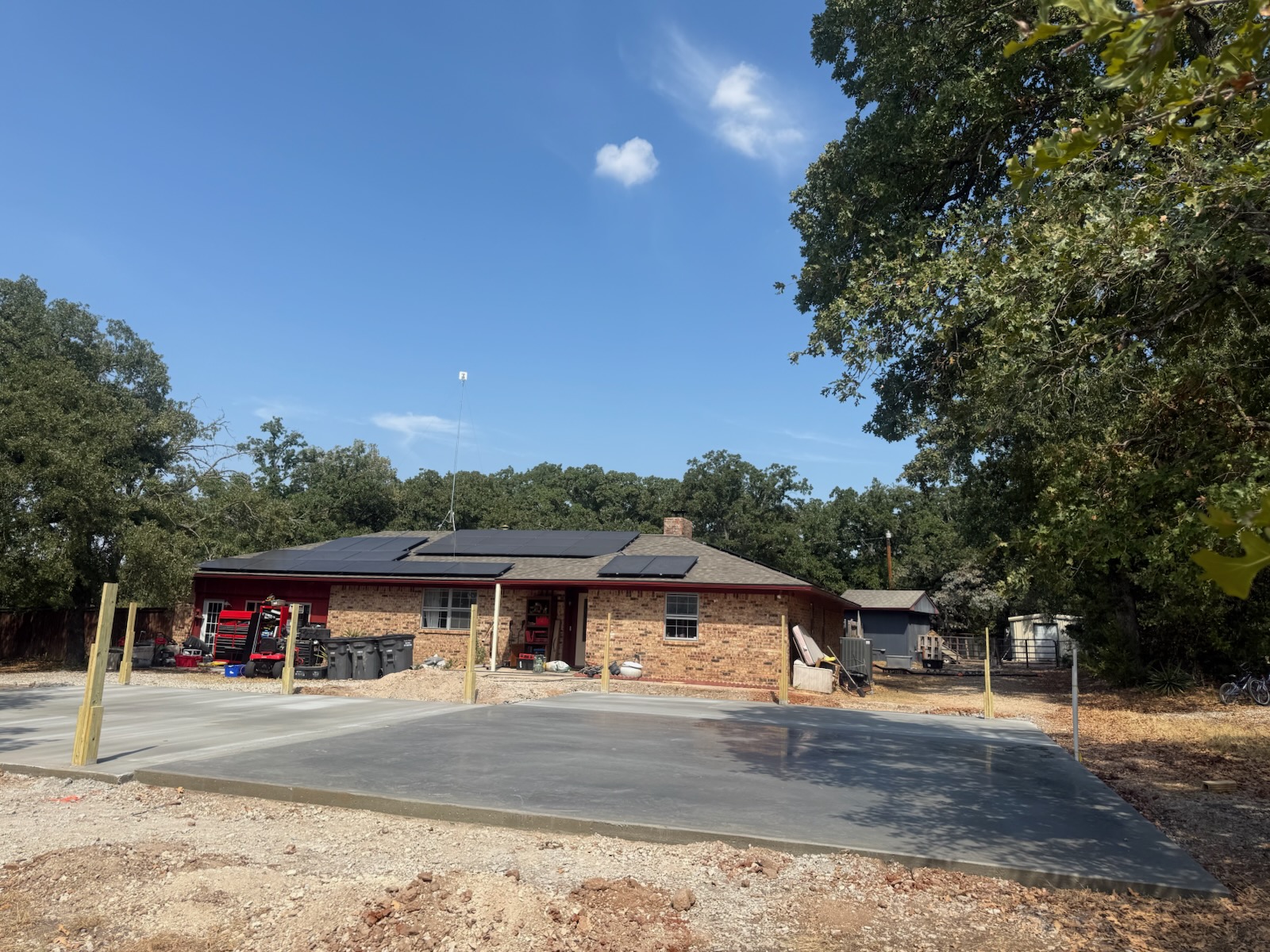
Published national figures from HomeGuide put poured concrete flatwork at roughly $6 to $15 per square foot, with plain gray at the low end and stamped or decorative finishes at $15 to $25 or more. A 400-square-foot patio lands near $2,400 to $6,000. Every project is quoted on site after a free estimate.
What does a concrete patio actually cost in Fort Worth?
There is no honest flat answer, but there are honest ranges. HomeGuide's concrete flatwork cost data puts poured concrete at about $6 to $15 per square foot for standard gray through basic decorative work, with price driven by size, design complexity and location. Those are national figures, not a Fort Worth quote, and we publish them so you have a starting point rather than a blank page.
On our side, the number comes from the site. We measure, look at how we get equipment and concrete to the pour area, check what has to come out first, and price the slab we actually have to build. The estimate is free and it is written down, so you can read the scope before anyone pours anything.
I have been doing concrete work for 15 years around the Fort Worth and Dallas area. In that time I have never seen two backyards price the same, which is why a phone estimate from any contractor is a guess until someone walks the property.
How does square footage change the math?
Size is the first lever, and it is not purely linear — a bigger pour spreads the cost of mobilization, forming setup and crew time across more square feet. HomeGuide's size table gives a useful sense of scale: about $1,200 to $3,000 for 200 square feet, $2,400 to $6,000 for 400 square feet, and $5,200 to $13,000 for 864 square feet.
In patio terms, 200 square feet is a 10 by 20 slab — room for a table and four chairs or a grill station. Four hundred square feet, roughly 20 by 20, fits a dining set plus a seating area. Eight hundred and sixty-four square feet is a full outdoor living footprint with multiple zones.
If you are close to a size break, it is worth asking what the next size up adds. Going from 16 by 20 to 20 by 20 is often a smaller jump in price than people expect, because the crew, the forms and the trip are already paid for.
Why does the finish swing the price the most?
Finish is the single biggest variable per square foot. HomeGuide's quality tiers run standard plain gray at $6 to $10 per square foot, a basic stain or broom finish at $10 to $15, mid-range stamped or multi-color work at $15 to $20, and high-end decorative at $20 to $25 or more.
A broom finish is the workhorse: textured for grip, easy to keep clean, and the least expensive thing we can hand you that still looks finished. Stamped and colored work costs more because it takes more labor, more material and more time on the surface while the concrete is still workable — there is no going back and redoing it later.
If you like the look of pattern or color, see what the options look like on our decorative concrete page and get more ideas in our post on decorative concrete for North Texas outdoor spaces. It is easier to decide before forming than after.
What are the seven things on our estimate that move your number?
Project size sets the base. More square feet means more concrete, more forming lumber and more finishing time, though the per-foot rate usually softens as the slab grows.
Access decides how the concrete gets to the pour. A front yard the truck can reach from the street is the cheapest case. A backyard behind a narrow gate means buggies, wheelbarrows or a pump, and that is labor and equipment added to the day.
Demolition is a separate line. If there is an old slab, deck footing or stone to remove and haul off, that is work before the work. Site preparation covers grading, compaction and getting the base right so the slab sits on something stable — our post on preparing your yard for a concrete project walks through what that looks like.
Reinforcement, thickness and finish round it out. Rebar or mesh adds material and tie time, a thicker slab is more cubic yards, and the finish is the labor and material on the surface. All seven get discussed before work begins so there are no surprises in the middle.
Why do access and demolition cost more than people expect?
A ready-mix truck has a chute with limited reach. When it can back up to the forms, a pour that takes a crew two hours by chute can take most of a day by wheelbarrow or buggy. Nothing about the slab changed — only how many hands and how many trips it took to place it.
Narrow side gates, slopes, mature trees, fences that have to come apart and go back together, soft ground after rain: all of it shows up as time. If a pump truck is the sensible answer, we will say so and explain what it adds.
Demolition is similar. Removing a 4-inch patio slab is straightforward. Removing one that was poured 8 inches thick with rebar through it, or one sitting against the house, takes equipment, time and a dump run. We would rather price that honestly up front than discover it on day one.
Do you need a permit for a patio in Fort Worth?
For a patio slab poured at grade in your own backyard, generally no building permit is involved. The City of Fort Worth does state that all platforms, walks and decks more than 6 inches above grade require a building permit, with location rules varying by zoning classification — see the city's residential permit information page.
That means a raised patio, a stepped slab or a covered structure can cross into permit territory even when a flat slab on the ground does not. Driveway approaches and public sidewalks in the parkway are a separate matter and require permits pulled by a bonded contractor.
Rules change and every lot is zoned differently, so confirm your specific project with the City of Fort Worth before you commit to a design. If you are outside city limits or in another jurisdiction, check with that city or county office.
What is included in a written estimate?
Our estimate is free and it is written. It states the scope we agreed on — the size, the thickness, the reinforcement, the prep, the finish — so you can compare it against anyone else's number line for line instead of comparing two totals.
We offer a warranty, and the project-specific terms are confirmed in that written estimate. Read them before you sign. Any contractor who will not put scope and warranty in writing is asking you to take their word for it.
To get on the schedule, call (817) 210-5188 or use the contact page. We work by appointment Monday through Saturday, out of Rhome and across the Fort Worth and Dallas area. You can also read more about the process on our concrete patio service page.
Frequently asked questions
- Is a concrete patio cheaper than pavers?
- Poured concrete is usually the lower-cost option per square foot, mainly because it is one placement instead of setting individual units by hand. Pavers can be repaired piece by piece, which concrete cannot. The right comparison is two written estimates for the same footprint and the same base prep.
- How long before I can use the new patio?
- Concrete gains strength over time rather than all at once. We give you specific timing for walking on it and putting furniture on it in writing when the slab is poured, because temperature and humidity change the schedule. Our post on how North Texas weather affects concrete curing covers why.
- Do you charge for the estimate?
- No. The project estimate is free. We come out, look at the site, talk through size, access, prep and finish, and give you the number in writing.
- Does a thicker slab always cost more?
- Yes, because thickness is cubic yards of concrete. A 5-inch slab uses about 25 percent more material than a 4-inch slab over the same area. Whether you need the extra depends on use and what the base looks like, and we will tell you which one we recommend and why.