In Fort Worth, the city's Code of Ordinances § 30-1 places the duty to repair a defective, unsafe or hazardous sidewalk on the abutting property owner, who has 30 days from written notice by the director of public works to act. Confirm your specific situation with the City of Fort Worth.
What does the Fort Worth ordinance actually say?
Fort Worth's Code of Ordinances § 30-1 declares any sidewalk, parkway, driveway or curb that is defective, unsafe or hazardous to be a nuisance. The duty to construct, reconstruct or repair it falls on the owner of the abutting property, and the code also names the owner's agent or the tenant.
The clock matters. Once the director of public works gives notice, the ordinance gives 30 days to complete the work. Failure to comply is treated as a misdemeanor under the same section.
That is the plain reading of the code as published. Ordinances get amended, and the city reads your address and your situation differently than a blog can, so confirm with the City of Fort Worth before you make a decision based on a deadline.
When do you have to build to current city standards?
Repairing a cracked panel is one thing. Building a sidewalk, parkway, curb and gutter to the city's current design standards is another, and § 30-1 ties that heavier requirement to construction activity.
Under the code, an owner is required to install sidewalk, parkway, driveway or curb and gutter to current city design standards where the owner is doing new construction or redevelopment equal to or exceeding 50 percent of the assessed value of the existing improvements. Below that threshold, the requirement reads differently.
If you are in the middle of a remodel or an addition, this is worth asking about early. The City of Fort Worth's residential permit information is the place to start, and we are happy to walk the site with you before you commit to a scope.
What if you disagree with a notice from the city?
The ordinance does not leave you with only two options. It provides an appeal route: first to the director of the transportation and public works department, and from there to the city manager.
If you believe the sidewalk in front of your property is not defective, or that the work being asked for goes beyond what the code requires, that appeal path exists in writing. Read the section yourself and talk to the department before the 30 days run out.
We are a concrete contractor, not a legal advisor. We can tell you what a slab looks like and what it would take to fix it. Questions about liability, notices and appeals belong with the city.
What makes a sidewalk "defective or unsafe" in practice?
On a walk-through, the things that get flagged are usually simple to see. A vertical offset where one panel has lifted above the next is the most common trip hazard, and it is the one a mail carrier or a neighbor notices first.
Beyond offsets, we look at cracking that has split a panel into loose pieces, panels that have sunk and now hold water after a rain, and slope that pushes water toward a house or a garage instead of away from it. A walkway that ponds is a walkway with a drainage problem underneath it.
Spalling and crumbling edges matter too, especially at entry approaches where people step up. If the surface is breaking apart rather than simply cracked, patching tends to buy very little time.
Repair one section or replace the whole run?
The honest answer depends on what is under the concrete. If a single panel has lifted over a root or settled over a soft spot and the rest of the run is sound, cutting out and replacing that section is usually the sensible call. The joints are already there; we work to them.
When several panels along the same stretch have moved, or when the base has washed out, replacing section by section means coming back again. In that case removal and replacement of the run gives you a consistent slope, a compacted base and clean joints, and you stop paying for repeat visits.
Junior Concrete handles walkways and paths, entry approaches, and removal and replacement, so we are not steering you toward whichever of those we happen to do. Juan has been pouring concrete for 15 years; the recommendation comes from what the site shows. Our concrete sidewalk service page covers the scope, and if you are weighing a patch against a full pour, repair or replace an uneven sidewalk goes through the same decision.
What happens during a sidewalk replacement?
The sequence is straightforward. We remove and haul the old concrete, prepare and compact the base, set forms to the slope we want, place the concrete, then finish the surface. Slope and drainage get set at the forming stage, because that is the only point where they are still adjustable.
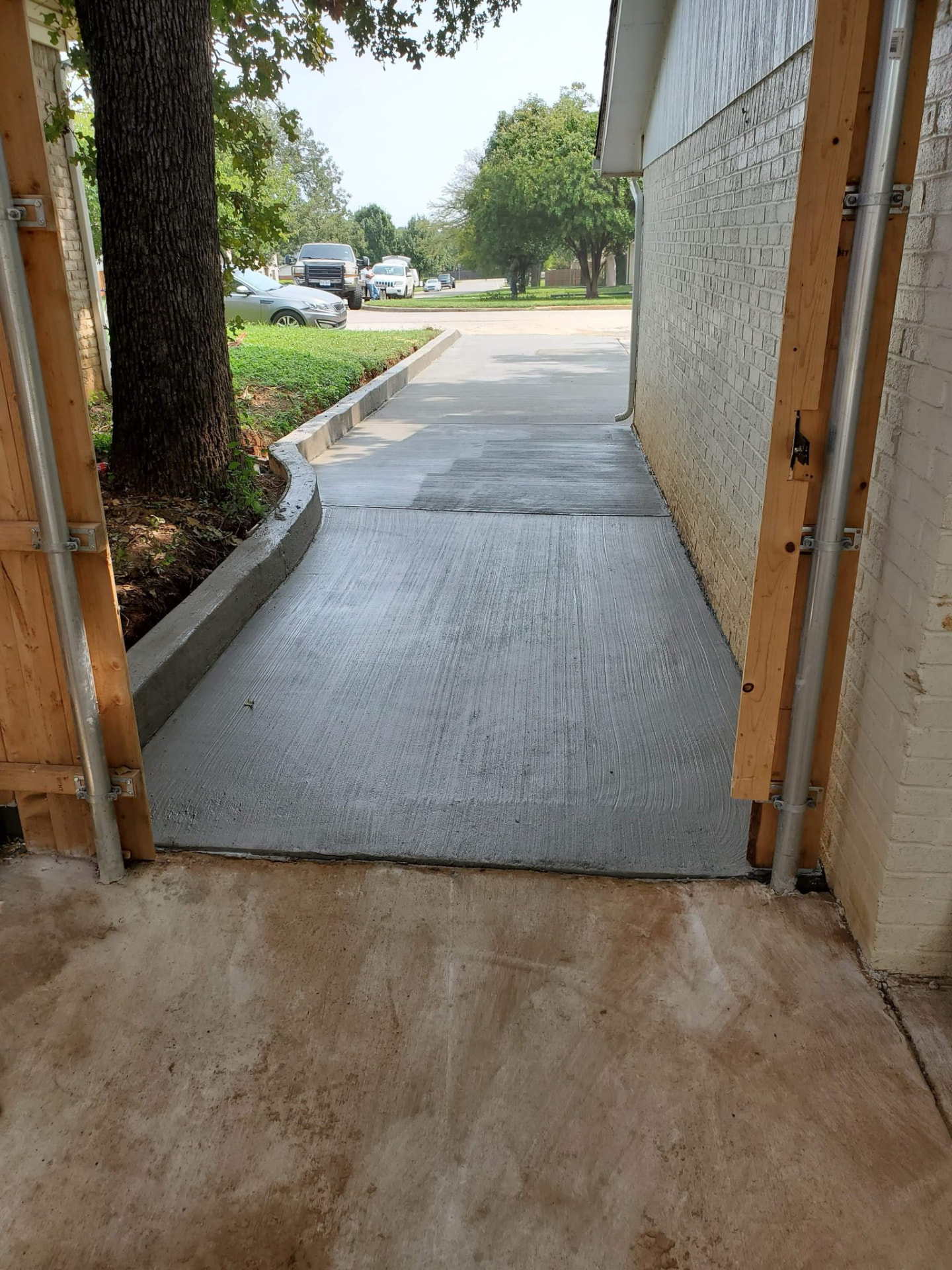
Access shapes the day more than homeowners expect. A front walk a few feet from the drive is a different job than a side path behind a gate where everything moves by wheelbarrow. We talk through access, scope and finish before work begins so there are no surprises in the middle.
North Texas weather drives the schedule after the pour. If you want the detail on that, see how North Texas weather affects concrete curing.
What drives the cost of sidewalk work?
We quote every project on site, because the same square footage can price very differently. The factors that move the number are project size, access, how much demolition is involved, site preparation, reinforcement, slab thickness and the finish you choose.
Removal of an existing walk adds labor and haul-off. A path that equipment can reach costs less to pour than one that cannot. Thicker slabs and added reinforcement cost more up front and are sometimes the right choice where vehicles cross.
The estimate is free. Call (817) 210-5188 or use the contact page and we will set a time — we work by appointment, Monday through Saturday. A warranty is offered, with the project-specific terms stated in your written estimate.
Frequently asked questions
- Will the City of Fort Worth repair the sidewalk in front of my house?
- Code of Ordinances § 30-1 places the duty to repair a defective sidewalk on the abutting property owner. Whether any city program assists with cost is a question for the City of Fort Worth directly — ask before assuming either way.
- Do I need a permit to replace a sidewalk in Fort Worth?
- Work in the public right-of-way and work tied to new construction can carry permit and design-standard requirements. Start with the City of Fort Worth residential permit information page and confirm with Development Services for your address.
- How soon can we walk on a new sidewalk?
- Concrete gains strength over time rather than all at once, and weather affects the pace. We tell you at the pour when the walk is ready for foot traffic and when to keep vehicles and heavy loads off it.
- Is sidewalk work covered by a warranty?
- Junior Concrete offers a warranty, and the terms that apply to your project are confirmed in the written estimate. Read that section before you sign so the coverage is clear on both sides.
- Do you work outside Fort Worth?
- Yes. We are based in Rhome and work across the Fort Worth and Dallas area. See our service areas or call (817) 210-5188 to check your address.