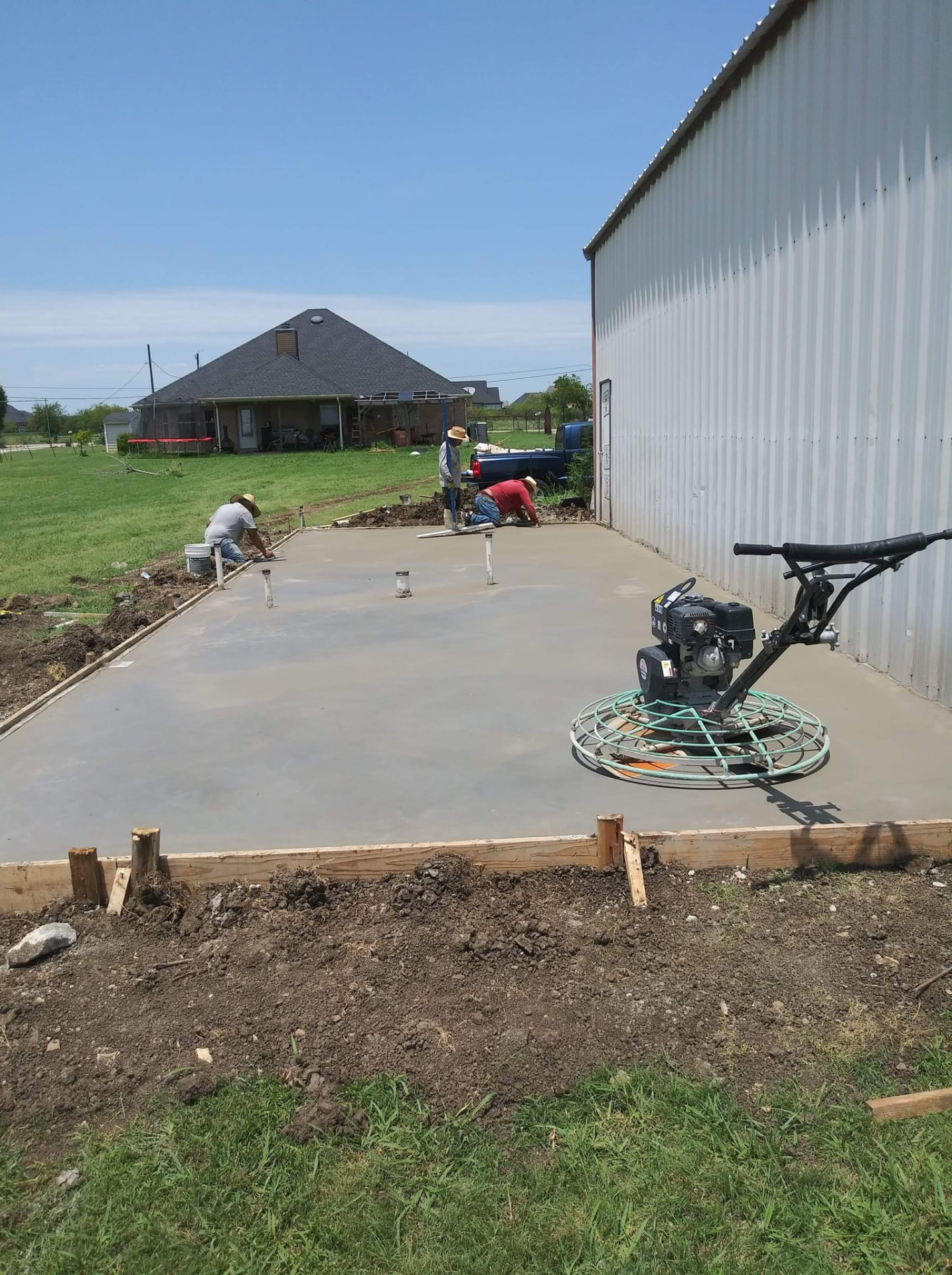
Yes. Concrete is poured through North Texas winters routinely. Cold changes the timing and the protection, not whether the job can happen. Expect a slower set, a longer wait before foot traffic and vehicles, and a pour scheduled around the forecast. Wet ground usually delays a project more than cold air does.
Can you pour concrete in cold weather in Texas?
You can, and we do. Winter in the Fort Worth and Dallas area is mild compared with most of the country, and the cold spells that matter tend to be short. A few days of freezing nights in January is a scheduling problem, not a reason to shut down for the season.
What changes is how the job is planned. In summer the concern is concrete setting too fast in the heat. In winter it is the opposite: the chemical reaction that hardens concrete slows down when it gets cold, so the slab takes longer to reach the point where it can carry weight.
That is the honest tradeoff. A winter pour is not a lesser pour. It is a pour that needs a better forecast read and more patience before you start using the surface.
What cold actually does to a fresh slab
Concrete gains strength through a reaction between cement and water, and that reaction is temperature sensitive. When it is cold, it runs slower. The same slab that could take foot traffic in a couple of days in October might need noticeably longer in January.
The practical effect for you is the waiting period. Cure time depends on the project and the weather, and we will explain when normal foot traffic and furniture can safely return on your specific job. For a driveway, vehicles always wait longer than people do.
Finishing also takes longer. Crews wait on the surface to be ready before they can work it, so a winter pour day can run later than the same job in spring. That is normal and it is planned for.
Why a cold snap mid-cure matters more than pour day
Homeowners usually ask about the temperature on the day of the pour. The more important question is what the next several nights look like. Fresh concrete is most vulnerable in the first days after placement, while it still holds free water and has not built much strength.
A sunny 60-degree afternoon followed by three hard freezing nights is a harder set of conditions than a chilly, steady week. That is why we look at the forecast window around the pour rather than a single day's high.
When freezing nights are coming, the slab gets protected so it holds its own heat while it sets. If the window is bad enough that protection will not be enough, we move the date. Moving a pour by a few days costs nothing. Pouring into the wrong week can cost you the slab.
Rain and wet ground delay more projects than cold does
In practice, the thing that pushes North Texas winter jobs is water, not temperature. Concrete sits on a prepared base, and that base has to be graded and compacted. Saturated ground will not compact properly, and equipment working wet soil tears up the site.
After a soaking week we often need the ground to dry before site preparation can start. That is true in April as well as January, but winter rain dries slower because there is less sun and less heat.
If you are getting a yard ready for work, the drainage and access notes in our guide on how to prepare your yard for a concrete project apply year-round and matter more in the wet months.
Why winter is often the better time to book
Spring is when everyone calls. From roughly March onward, every concrete crew in the Fort Worth–Dallas area is booking out, and the homeowner who waited until the first warm weekend ends up at the back of the line.
Booking in winter usually means more choice of dates and more time to plan the job properly. We go over the site, the scope and the finish before any work begins, and that conversation is easier when the calendar is not stacked.
Even if the pour itself ends up scheduled for early spring, the measuring, the layout decisions and the written estimate can all be handled now. The work ahead of the pour is the part that benefits most from unhurried time.
What your estimate should tell you about timing
A written estimate should not just give you a price. Timing depends on the scope, site conditions and weather, and your estimate will explain the expected schedule, including what happens if the forecast moves the date.
Ask any contractor you talk to how they handle a freeze in the days after your pour, and how long you will need to stay off the surface. If you get a vague answer, keep asking. The list in our post on questions to ask a concrete contractor is a good starting point.
For slab work specifically, the layout, preparation, forming and placement steps are the same in winter as any other season. You can see how we handle that on our concrete foundations page.
Junior Concrete works by appointment, Monday through Saturday, serving Fort Worth and Dallas from Rhome. Project estimates are free. Call (817) 210-5188 to get on the schedule or to talk through a spring project while there is time to plan it.
Frequently asked questions
- Will a slab poured in winter be weaker than one poured in summer?
- Not if it is planned and protected correctly. Cold slows how quickly concrete gains strength, so it needs more time and, during freezing nights, protection while it sets. What causes a weak slab is freezing early in the cure without protection, not cold weather itself.
- How much longer before I can use a winter pour?
- Longer than in warm weather, and the exact wait depends on the project and conditions. Cure time varies by job, and we tell you on site when normal foot traffic and furniture can return. Vehicles always wait longer than foot traffic on a driveway.
- Do you work year-round?
- Yes. We work by appointment, Monday through Saturday, through the winter in the Fort Worth and Dallas area. Individual pour dates move with the forecast, but the season does not stop the work.
- What conditions stop a pour entirely?
- A run of freezing days and nights with no window to protect the slab, heavy rain on the day, or ground too saturated to compact a proper base. In those cases we reschedule rather than pour into conditions that will affect the finished surface.
- Should I just wait until spring to call?
- You do not need to. Spring is the busiest season, so dates fill quickly. Getting the site reviewed and the written estimate done over the winter means the job is ready to go whenever the weather window opens.