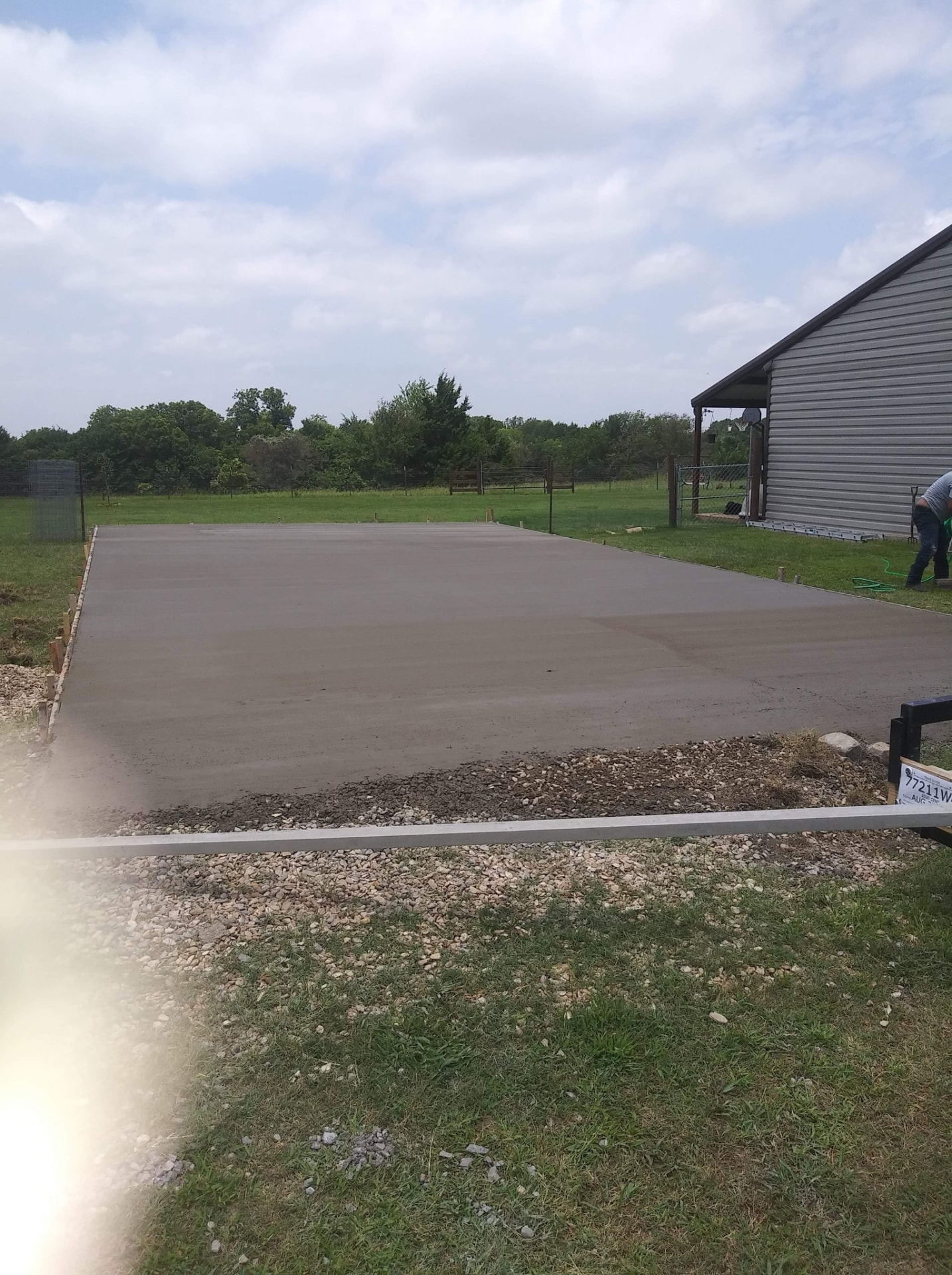
Most residential concrete driveways are poured about four inches thick, with five to six inches used where heavier vehicles, RVs or trailers park. Thickness and reinforcement are the two spec lines that most change price and service life, so ask every bidder to put both in writing before you compare bids.
What driveway thickness actually means in practice
Thickness is the depth of the finished slab, measured from the compacted base to the surface. For a car-and-pickup driveway, four inches is the common residential standard. Where heavier loads park regularly — a dually, an RV, a loaded trailer, a work truck — five to six inches is the usual step up. HomeGuide lists the same split in its national pricing breakdown, where thicker pours carry a higher per-square-foot cost (https://homeguide.com/costs/concrete-driveway-cost).
The decision is not about the whole driveway being one depth, either. Plenty of jobs get a standard slab across the approach and parking area with a thicker section where the trailer sits. If you tell us up front what will be on the concrete, we can spec it that way instead of guessing.
The problem with a bid that never mentions thickness is that you cannot compare it to anything. Two quotes for the same square footage can be hundreds of dollars apart purely because one is a four-inch pour and the other is five, and nothing on the page tells you which.
Wire mesh, rebar, fiber — what is each one for?
Reinforcement does not stop concrete from cracking. It holds the slab together across a crack so the two sides stay level and tight instead of separating and lifting. That is the whole job.
Welded wire mesh is a grid of light steel laid in the slab, typically used on standard residential pours. Rebar is heavier steel bar tied into a grid at a set spacing, used where loads are higher or where the owner wants a stronger slab. Fiber is mixed into the concrete itself and helps control the fine shrinkage cracking that shows up early; it is not a substitute for mesh or bar where steel is called for.
Here is the part that matters when you are reading bids: the word "reinforced" by itself is not a specification. A real one names the material, the size and the spacing — for example, rebar on a stated grid spacing, or mesh of a stated gauge. It should also say how the steel is held up off the base so it ends up inside the slab rather than lying on the dirt underneath it. We put those details in our written estimates, and you should expect the same from anyone else you are considering.
Why the base under the slab matters as much as the slab
Concrete is strong in compression and weak in bending. A four-inch slab on a well-prepared, evenly compacted base will outlast a thicker slab sitting on soft spots, loose fill or old broken concrete that was never removed.
Our driveway work includes removal when it is required, then base and form preparation before any concrete is placed, then placement and finish. The preparation stage is where the forms get set to the right grade and fall, the base gets worked to a consistent surface, and drainage is sorted out so water leaves the slab instead of pooling on it or running back toward the house.
If a bid is noticeably cheaper than the others, the base is usually where the money came out. It is also the part you cannot inspect after the pour. We cover what this stage looks like in more detail in our guide to preparing your yard for a concrete project.
Control joints: deciding where the concrete cracks
Concrete shrinks slightly as it cures, and that shrinkage has to go somewhere. Control joints are the grooves cut or tooled into the surface at planned intervals. They create a weak line so the slab cracks along the joint, where it is straight and barely visible, rather than wandering across the middle of your driveway.
A joint plan is part of the spec, not an afterthought. The layout should relate to the width of the driveway and the shape of the pour, and the joints need to be cut deep enough and early enough to do their job.
When a bidder walks your driveway, ask where the joints will go and why. If the answer is vague, that is useful information about the rest of the job.
What makes driveway concrete crack?
Soil movement, drainage, loads and natural concrete shrinkage can all contribute. Good preparation and planned joints help manage cracking.
Notice the word manage. Any contractor who tells you a concrete driveway will never crack is telling you something concrete does not do. What a sound driveway does is crack where it was designed to, in thin lines that stay tight and level, instead of opening up and shifting.
Thickness, reinforcement, base preparation and joints all work together on that. Getting three of the four right and skipping one is how driveways go wrong.
How thickness and reinforcement show up on your estimate
Our pricing is affected by project size, access, demolition, site preparation, reinforcement, thickness and finish. Thickness raises the volume of concrete; reinforcement adds material and labor to place and tie it. Both are real line items, and both are things a bidder can quietly reduce to come in low.
For general context on what driveways cost nationally, HomeGuide puts concrete driveways at roughly $6 to $15 per square foot, or about $2,400 to $8,600 for a typical two-car driveway (https://homeguide.com/costs/concrete-driveway-cost). Those are national averages, not Fort Worth or Dallas numbers, and they are not our prices. Every project is quoted on site after we look at access, what has to come out and what is going back in.
We give free project estimates in writing, and the estimate is where the scope and the warranty terms are confirmed. If you want a thicker slab or heavier reinforcement than the standard, say so during the walkthrough and we will price it both ways.
What to ask before you sign
Five questions will separate a sound bid from a cheap one. What thickness is the slab, and is any section thicker? What reinforcement is included — material, size and spacing? What happens to the base before the pour, and is removal of the old driveway included? Where will the control joints go? What are the warranty terms, and are they written down?
A contractor who explains the spec has no reason to hide it. We have been doing concrete for 15 years and would rather spend twenty minutes on the driveway talking through thickness and steel than have you compare three bids that all just say "concrete driveway."
You can see our full process on the concrete driveways service page, and there is a longer list of screening questions in our post on questions to ask a concrete contractor. When you are ready for numbers, call (817) 210-5188 or use the contact form for a free project estimate.
Frequently asked questions
- Can I pour new concrete over an old driveway?
- Sometimes, but it is rarely the right call. Overlaying traps whatever problem caused the old slab to fail and raises the driveway height at the garage and the street approach. Our driveway work includes removal when it is required so the new slab sits on a base we prepared. We will tell you on site which applies to your driveway.
- Is a thicker driveway always better?
- No. A thicker slab on a poor base is still a poor driveway. Added thickness pays off when the loads justify it — RVs, trailers, heavy trucks — but for a normal car and pickup driveway, money is usually better spent on base preparation and proper reinforcement than on extra depth.
- How long before I can park on a new concrete driveway?
- Curing time depends on the mix, the slab and the weather, so we give you a specific hold time for your pour in writing rather than a rule of thumb. Walking on it happens well before driving on it. Our post on how North Texas weather affects concrete curing explains why the timeline shifts with conditions.
- Do you offer a warranty on driveway work?
- Yes, we offer a warranty. The specific terms are confirmed in your written estimate so you have them in hand before work starts, rather than as a verbal promise.
- Do you work outside Fort Worth?
- We are based in Rhome and work across the Fort Worth and Dallas area. Call (817) 210-5188 with your address and we will tell you straight away whether your project is in range. We schedule by appointment, Monday through Saturday.